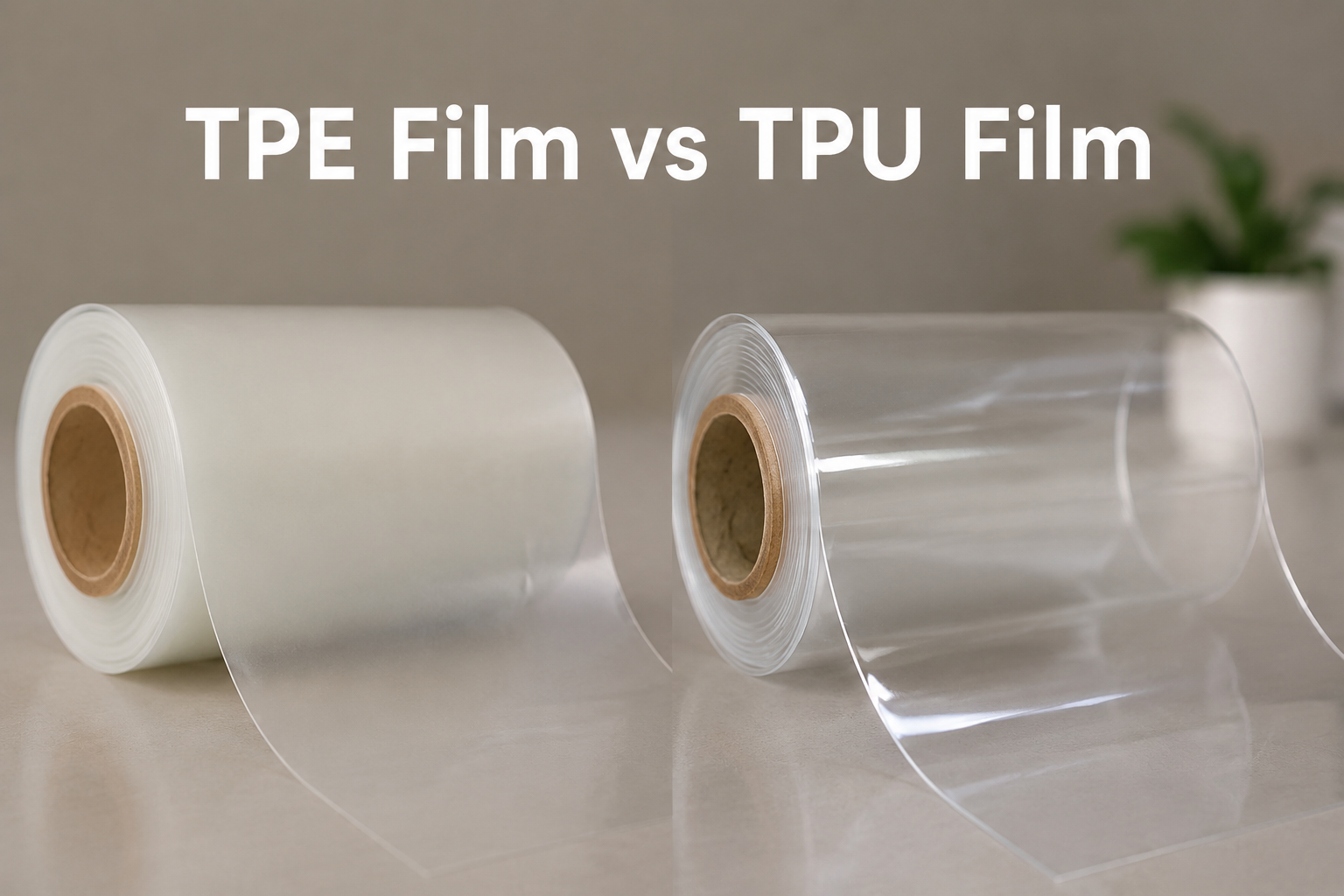
In a packaging, manufacturing, or product design career, material decisions are important. TPE and TPU films are two materials that frequently appear in these industries. Both are flexible. Both are durable. However, they aren't identical. You can influence product quality, budget, and production process by the wrong one. In both cases, this article explains them in simple terms to help you make your selection.
TPE and TPU are both types of plastic film that can be stretched and flexed, then return to their original shape. They are soft and rubberlike, compared to hard plastics. This is where they come into play in various sectors.
TPE film is a vast category. It contains a variety of rubber-like plastics. TPU film, on the other hand, is a specific material. It is part of the TPE family but has a distinctive chemical composition, which offers superior performance in several fields.
TPE film is a product that combines various polymers. Manufacturers can modify the blend to obtain various hardness levels and stretchness. This makes TPE very flexible to produce. It is very simple, and the raw materials are abundant.
TPU film needs to undergo a more controlled process. It is made by reacting polyols with diisocyanates. This is a chemical reaction that results in a highly bonded material. The additional strength and resistance of the TPU are due to those bonds. The process is more time-consuming, contributing to the higher cost of TPU.
The winner here is TPU film. It has high tensile strength. It can be bent thousands of times without cracking. Moreover, TPU offers a higher temperature resistance than most TPE films. It remains flexible in cold conditions, but it withstands moderate heat.
The TPE film isn't weak, but it has its limitations. It could stretch excessively or wear out the TPU under high loads or mechanical stress. TPE will perform well for its intended lighter, medium use. TPU is more reliable for demanding applications, however.
Yes. In general, the TPE film is less expensive than the TPU film. The raw materials are cheaper. The manufacturing process is simpler. Besides, TPE has a greater supply, making its cost more competitive.
The complex manufacturing process and high-quality materials make the TPU film the more expensive option. The initial capital investment is typically, though, compensated in the long run. TPU has a longer lifespan and performs well, potentially reducing replacement costs over time.
Both films are soft and flexible. However, they differ in their usage. TPE film has a soft, rubbery feel. It fits well on the skin and is hence used in consumer goods and medical products. In some grades, it also has a tacky surface.
The TPU film is also more elastic and bouncier. It snaps back quickly when stretched. It is also typically smoother and of higher quality. It is also popular in the manufacturing of sportswear, shoes, and premium packaging applications.
TPE film has a wide range of applications. It's used in medical tubing, food packaging, baby items, and household items. It also finds applications in the automotive interiors where a soft touch finish is required. It is safe, easy to process, and inexpensive, which makes it a good fit to use in mass-market production.
TPU film is used in products that require performance under pressure. Consider shoe soles, phone cases, inflatable, protective films on electronic devices, and medical devices that are frequently flexed. It is also for use in automotive padding and outdoor products such as backpacks and tents. No matter which level of durability and stretch recovery is most needed, TPU is the material to look to.
TPU film resists oils, greases, and most chemicals. It's also very resistant to UV light and the outdoors. It is therefore appropriate to use it outdoors and in industrial areas.
TPE film is chemically resistant, but not as effectively as HDPE film. It is useful in normal conditions, but can be reduced with exposure to harsh chemicals or UV light. Additives enhance some TPE; however, TPU remains the best in this category.
This is a common worry among all industries. Here, TPE film offers an advantage. Many of the TPE's grades are recyclable and do not contain harmful plasticizers such as PVC-related ones. Often, their quality can be maintained even when reprocessed.
TPU film is also recyclable, though the process may be more complex. Certain TPUs contain components that hinder the recycling process. The advantage of TPU, however, is that it's long-lasting, which further reduces waste.
Bio materials are also being developed for both materials. This is driving TPE and TPU towards "greener" manufacturing processes.
TPE film is easier to process. It is also readily bonded to other products and colors. No special surface preparation is needed for printing with TPE. It is readily cut, welded, and sealed as well.
Processing of the TPU film requires a little more care. The surface treatment is sometimes required before printing or bonding. When processed properly, however, TPU will retain prints and adhesives well. It can also be used for hot-press lamination in the garment and footwear industry.
Consider what is truly required in this product. TPE is an excellent choice when considering using a film for general applications and low cost. TPU is the product for products subject to repeated stretching, heavy mechanical stress, and outdoor exposure. Consider your budget, how you will produce it, and if recyclability is important to your customers.
TPE and TPU films are both important in present-day manufacturing. There is no uniform rule for choosing one. It all depends on your product needs, quantity, and final use. To truly understand the differences, you can source more effectively and create better products.
1- Where to purchase TPE Film or TPU Film in Bulk Supply for a retail business?
TPE and TPU films can be purchased directly from manufacturers in China, South Korea, and Taiwan.
2- Is there any way to find TPE Film or TPU Film wholesale at reasonable rates?
Check with manufacturers for better pricing, without having to go through the middleman.
3- Can I find a TPE Film and TPU Film Supplier who can provide customization services?
A wide range of manufacturers in China provide 100% customization of TPE and TPU film in terms of thickness, width, surface texture, and color.
4- Is There Any TPE Film or TPU Film Supplier Who Offers Bulk Supply with Customization at Low Prices?
Yes, a lot of Asian manufacturers will supply bulk at custom requirements at a competitive price.
Hospital-acquired infections touch 1 in 25 patients. That was th
READ FULLIf you are looking to source TPE film from a market that combines technical rigor with industrial
READ FULLIn a packaging, manufacturing, or product design career, material decisions are important. TPE an
READ FULL