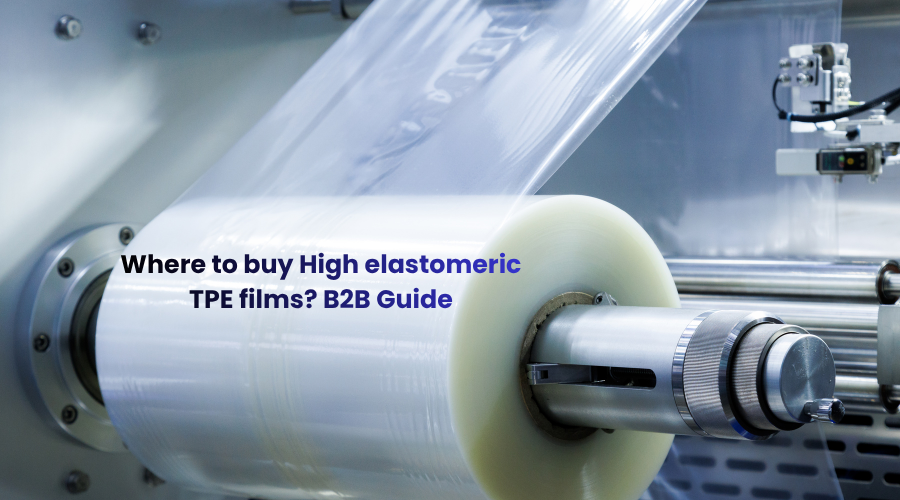
Manufacturers across the medical, hygiene, and wearable tech sectors are leaving latex and standard thermoplastics behind. They’re moving to high elastomeric TPE films. The reasons are clear. This material is overall much superior to standard latex and other thermoplastics. It has superior stretch, reliable recovery, and design flexibility that older materials simply can’t match.
But there is a challenge that is faced by bulk buyers of this material. Availability of genuine quality TPE film. For every legitimate specialty compounder, a dozen generic trading companies claim to offer the same film. Discerning buyers know better. They prefer direct manufacturer relationships. Having a stable relationship with a direct manufacturer means verifiable technical data, consistent gauge tolerance, and a supply chain that doesn’t crumble under volume.
What this list excludes is just as important as what it includes. You won’t find simple plastic bag extruders or anonymous Alibaba resellers here. This is a curated list of established entities with documented formulation know-how and industrial-scale slitting and converting infrastructure. These are partners, not just vendors.
Teknor Apex is a privately held global leader. Their real strength is vertical integration, controlling the chemistry from custom-compounded pellet all the way to the finished monolayer or coextruded film.
Key Products: Medalist® Medical TPE films, high-traction grip films, and breathable elastic laminates for hygiene applications.
Benefit for Commercial Buyers: This integration means an ultra-tight control over polymer quality and composition. The final result is a product with a consistent stretch-force curves on your high-speed converting line. It’s not just a material; it’s process reliability.
What to Ask About: Explore their toll compounding services if your volume justifies a proprietary formulation. Also, inquire about the MOQ for custom color-matched, sub-25-micron films.
AFEL Polyfilms, established in 1973 in South Korea, isn’t a sprawling conglomerate. They are a focused, five-decade-old powerhouse in TPU and specialty films. Their expertise is deep, not just broad. They have been quietly supplying a diverse customer base across the EU, China, and beyond.
Key Products: Elastomeric TPE Film, Elastomeric TPU Film, Wearable TPU Film, Transparent TPU Film, Flame Retardant TPU Film, Anti-Microbial TPU Film, and Paint Protection Film.
Benefit for Commercial Buyer: The advantage here is heritage and technical specialization. Five decades of manufacturing excellence is a clear indicator that this particular manufacturer has deep, proprietary know-how. This isn’t a line item for them; it’s their entire business. Their stated commitment to working closely with customers to tailor films is a distinct edge for OEMs with a precise stretchability requirement.
What to Ask About: As some probing questons about their custom formulation capabilities for your specific application. For regulated industries, initiate the conversation by requesting their standard RoHS/REACH compliance documentation and their MOQ for a new product development trial run.
Covestro needs little introduction, but let’s focus on what matters for procurement. Their Platilon cast TPU and Epurex films set the benchmark for mechanical strength and chemical resistance. They are a premier global manufacturer with serious application engineering support.
Key Products: Platilon for breathable outdoor textiles and medical wound care, and Epurex films offering unique texture properties with high elongation.
Benefit for Commercial Buyer: The buyer’s advantage is complete and detailed technical information of their products. Covestro provides comprehensive data on dynamic mechanical analysis (DMA) and heat-sealing behavior. This is essential data for engineers designing for automated assembly.
What to Ask About: Ask about their “Proof of Conversion” support program. Furthermore, check on the availability of bluesign certified grades if your apparel application demands sustainable credentials.
SWM, now part of Mativ, occupies a very specific, high-value niche. They specialize in sophisticated low-gauge elastic films and nets. Their films are engineered for the most demanding interface in a diaper or incontinence product: the hook-and-loop fastening system.
Key Products: Engineered elasticity films designed for silicone-coated release liners and mechanical fastening systems.
Commercial Buyer’s Advantage: This is a unique commercial advantage. Their films are designed to withstand repeated puncture and tear forces. They solve a specific product failure point, which makes them invaluable for that precise application.
What to Ask About: Inquire about their in-house silicone coating capabilities on your chosen elastic film substrate. Also, get clarity on their minimum slit width tolerances, critical information for narrow-web converters.
For a sustainable edge, look to Mitsubishi Chemical Group. They are investing heavily in bio-based polyester elastomer films. This offers a direct alternative where petrochemical reduction is a key design requirement.
Key Products: BIOFRONT non-phthalate, high-heat-resistant elastomeric films for functional sportswear and industrial membranes.
Commercial Buyer’s Advantage: The buyer’s advantage here is a verifiable chain of custody. They offer partial bio-content without sacrificing that critical elastic recovery. This is essential for brands pursuing a green premium.
What to Ask About: Don’t just take their word for it. Ask for third-party bio-content certification, such as ISCC PLUS. Also, request comparative tear-strength data against their own petro-based TPEs at low thicknesses.
Before you sign any bulk film contract, pause. Your process engineering and procurement teams must verify these parameters.
1. Stress-Strain Profile Verification:
Request the full hysteresis curve (load and unload), not just the elongation-at-break point. The permanent set percentage is the true measure of elasticity of the film.
2. Gauge Uniformity Certification:
Confirm the ± tolerance across the full reel width. A tight tolerance, like ±5% or better, is non-negotiable for high-speed slitting or cutting.
3. Coefficient of Friction (COF):
You must clearly specify both static and kinetic COF requirements. The specs data provided by the manufacturer should include film-on-film and film-on-metal. This metric is vital since it is a measure of how smoothly the sheet will unwind on your specific equipment.
4. Roll Dimensioning:
Clarify the tedious but crucial details like core size tolerance, splice-free length commitments, and whether the supplier provides a tail-hold feature for your automated roll-changing system.
Sourcing high-elastomeric TPE films is a strategic decision. The choice is between a transactional buy from a broker and a material solution hardened by rigorous testing and a reliable global supply. Partners like Teknor Apex and AFEL Polyfilms offer the latter.
Here is a final, practical piece of advice: do not buy a data sheet. Buy a proven production lot. Always begin your commercial relationship with a pre-production trial roll audit on your exact line. No supplier’s market reputation should replace this step.
1. Where can I buy high elastomeric TPE films in bulk?
You can purchase high elastomeric TPE films from specialized B2B manufacturers and industrial distributors. Always choose suppliers that offer factory pricing, quality certifications, and bulk supply capability.
2. What is the best source for TPE film wholesale supply?
The best source is a direct manufacturer or verified wholesale distributor with OEM/ODM services. This ensures better pricing, consistent quality, and reliable long-term supply.
3. What industries use elastomeric TPE films?
TPE films are widely used in medical, automotive, packaging, electronics, and industrial applications. They are valued for flexibility, durability, and excellent elastic performance.
4. How do I choose a reliable TPE film supplier?
Look for suppliers offering technical datasheets, sample testing, certifications, and stable production capacity. Experience in global export and bulk supply is also important.
5. What is the difference between TPE film and TPU film?
TPE films are softer and more flexible, while TPU films offer higher strength and abrasion resistance. The choice depends on whether you need elasticity or durability.
6. Can TPE films be customized for industrial use?
Yes, most suppliers offer customization in thickness, color, hardness, and surface finish. OEM and private label options are also commonly available for B2B buyers.
7. What is the MOQ for wholesale TPE films?
MOQ depends on the supplier and customization level. Standard bulk orders usually start from roll quantities, especially for industrial-grade production.
8. Are TPE films environmentally safe?
Yes, most modern TPE films are recyclable and free from harmful PVC materials. They also comply with environmental standards like RoHS and REACH.
9. Can I request samples before bulk ordering?
Yes, reputable suppliers usually provide samples for quality testing and application verification before confirming large-scale orders.
10. How long does delivery take for bulk TPE film orders?
Delivery time varies based on order size and customization. Standard orders are faster, while custom production may take additional manufacturing time.
Hospital-acquired infections touch 1 in 25 patients. That was th
READ FULLIf you are looking to source TPE film from a market that combines technical rigor with industrial
READ FULLIn a packaging, manufacturing, or product design career, material decisions are important. TPE an
READ FULL